
Contact Us
24/7 Online Customer Support
Product Introduction
Equipment Model Overview
Key Advantages
🔧 Advanced Structure, Risk-Free Operation
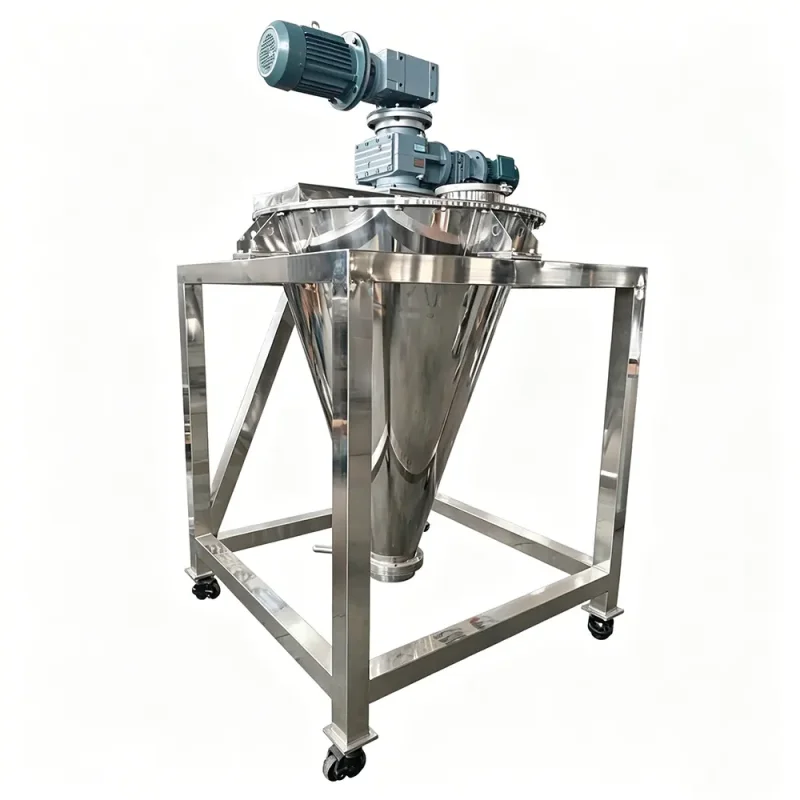
The bottom of the screw shaft features a bearing-free design, fundamentally eliminating powder leakage caused by bearing wear and seal failure for greater peace of mind during long-term operation.
⚡ Fast Mixing, Industry-Leading Uniformity
-
An asymmetric dual-screw configuration with one large and one small screw operates eccentrically, greatly expanding the mixing area and particularly excelling at materials with significant bulk density differences and highly disparate proportions;
-
Short mixing cycles significantly improve efficiency;
-
Coefficient of variation of uniformity CV ≤ 5%, far superior to industry standards;
-
Clean and thorough discharge with no residue in the vessel, making batch changeovers easier.
💰 Extremely Low Energy Consumption, Outstanding Energy Saving
The total operating power consumption is only 1/10 that of conventional drum mixers, offering clear long-term cost advantages.
🌿 Gentle, Non-Damaging Mixing Process
Materials are gently tumbled in the vessel, with no breakage, no abrasion, and no localized overheating, making it especially suitable for materials with requirements for particle shape and heat sensitivity.
🧊 Stable Finished Products, No Layering or Segregation
After mixing, materials remain highly homogeneous, with no layering or segregation during standing or conveying, ensuring consistent quality in every batch of finished product.
🔒 Fully Enclosed and Dust-Free, Durable
The entire machine adopts an enclosed structure to prevent dust leakage, offering easy operation and convenient maintenance. The conical vessel can be customized as a pressure vessel to meet production requirements for special operating conditions such as pressurization and vacuum.
🛡️ Flexible Vessel Material Options
Depending on material characteristics and hygiene requirements, carbon steel, 304 stainless steel, 316L stainless steel, and 321 stainless steel are available. Surface treatment can also be customized as required.
Why Choose Our Double-Screw Conical Mixer?
-
Precision Manufacturing: All core components are machined in a single setup using five-axis machining centers, with precision comparable to aerospace-grade standards;
-
Durable and Reliable Drive Core: The gears use Gleason spiral bevel gear technology from the United States, with alloy steel forging + carburizing and quenching, providing high load capacity and stable operation even under long-term heavy loads;
-
Custom-Designed Screws: For each type of material, the screw structure is independently designed through experimental data comparison + computer modeling;
-
Differentiated Screw Helix Angles: Different screw helix angles are customized according to material density, flowability, and the characteristics of main materials and additives to ensure optimal mixing trajectories;
-
Effortlessly Handles Extreme Ratios: Even with a main material-to-additive ratio as high as 1:1000, uniform mixing is achieved at both macro and micro levels.
Working Principle
Through the combined motion of planetary rotation + self-rotation, the double-screw conical mixer creates four material flow patterns within the vessel:
-
Planetary rotation—the two screws revolve around the centerline of the cone, driving materials in a circular circulation along the inner wall of the conical vessel;
-
Self-rotation—the screw blades rotate on their own axes, radially pushing materials from the vessel wall toward the center of the cone;
-
Materials rise upward within the conical vessel, naturally falling back along the outer edge of the screws after reaching the upper section while continuously mixing along the screw axis;
-
These motions combine to form four mixing mechanisms—convection, shearing, diffusion, and permeation—allowing powders to achieve macroscopic uniformity and fine microscopic distribution in a very short time.
Selection Guide · 6 Steps to Finalize Your Configuration
Step 1: Determine Single-Batch Processing Volume
Single-machine batch capacities range from 0.1~30 m³; select the most suitable specification based on your production capacity requirements.
Step 2: Determine Material for Product-Contact Parts
Only parts that directly contact materials, such as the vessel and screws, support material customization; non-contact components such as motors, gear reducers, and bearings use standard industrial materials.
Available materials: standard carbon steel, 304 stainless steel, 316L stainless steel, and 321 stainless steel. Surface treatments (polishing, coating, etc.) can be customized based on material adhesion, corrosiveness, and hygiene grade requirements.
Step 3: Match Motor Power
Accurate model selection is based on the following parameters:
-
Material bulk density
-
Material flowability (angle of repose, compression ratio, etc.)
-
Equipment startup conditions — no-load startup (standard) or loaded startup (heavy-duty conditions)
Step 4: Select Optional Auxiliary Systems
Add the following according to process requirements:
-
Liquid spraying system (atomized addition)
-
Heating jacket system (steam/thermal oil)
-
Cooling jacket system (circulating water/refrigerant)
Step 5: Standard Reserved Ports
Each machine comes standard with universal process ports:
-
Feed inlet
-
Cleaning and maintenance port
-
Exhaust and dust collection port
Step 6: Select Discharge and Drive Methods
Available discharge actuators:
-
Manual discharge
-
Pneumatic discharge
-
Electric discharge
Technical Parameters
Equipment Model Overview
Key Advantages
🔧 Advanced Structure, Risk-Free Operation
The bottom of the screw shaft features a bearing-free design, fundamentally eliminating powder leakage caused by bearing wear and seal failure for greater peace of mind during long-term operation.
⚡ Fast Mixing, Industry-Leading Uniformity
-
An asymmetric dual-screw configuration with one large and one small screw operates eccentrically, greatly expanding the mixing area and particularly excelling at materials with significant bulk density differences and highly disparate proportions;
-
Short mixing cycles significantly improve efficiency;
-
Coefficient of variation of uniformity CV ≤ 5%, far superior to industry standards;
-
Clean and thorough discharge with no residue in the vessel, making batch changeovers easier.
💰 Extremely Low Energy Consumption, Outstanding Energy Saving
The total operating power consumption is only 1/10 that of conventional drum mixers, offering clear long-term cost advantages.
🌿 Gentle, Non-Damaging Mixing Process
Materials are gently tumbled in the vessel, with no breakage, no abrasion, and no localized overheating, making it especially suitable for materials with requirements for particle shape and heat sensitivity.
🧊 Stable Finished Products, No Layering or Segregation
After mixing, materials remain highly homogeneous, with no layering or segregation during standing or conveying, ensuring consistent quality in every batch of finished product.
🔒 Fully Enclosed and Dust-Free, Durable
The entire machine adopts an enclosed structure to prevent dust leakage, offering easy operation and convenient maintenance. The conical vessel can be customized as a pressure vessel to meet production requirements for special operating conditions such as pressurization and vacuum.
🛡️ Flexible Vessel Material Options
Depending on material characteristics and hygiene requirements, carbon steel, 304 stainless steel, 316L stainless steel, and 321 stainless steel are available. Surface treatment can also be customized as required.
Why Choose Our Double-Screw Conical Mixer?
-
Precision Manufacturing: All core components are machined in a single setup using five-axis machining centers, with precision comparable to aerospace-grade standards;
-
Durable and Reliable Drive Core: The gears use Gleason spiral bevel gear technology from the United States, with alloy steel forging + carburizing and quenching, providing high load capacity and stable operation even under long-term heavy loads;
-
Custom-Designed Screws: For each type of material, the screw structure is independently designed through experimental data comparison + computer modeling;
-
Differentiated Screw Helix Angles: Different screw helix angles are customized according to material density, flowability, and the characteristics of main materials and additives to ensure optimal mixing trajectories;
-
Effortlessly Handles Extreme Ratios: Even with a main material-to-additive ratio as high as 1:1000, uniform mixing is achieved at both macro and micro levels.
Working Principle
Through the combined motion of planetary rotation + self-rotation, the double-screw conical mixer creates four material flow patterns within the vessel:
-
Planetary rotation—the two screws revolve around the centerline of the cone, driving materials in a circular circulation along the inner wall of the conical vessel;
-
Self-rotation—the screw blades rotate on their own axes, radially pushing materials from the vessel wall toward the center of the cone;
-
Materials rise upward within the conical vessel, naturally falling back along the outer edge of the screws after reaching the upper section while continuously mixing along the screw axis;
-
These motions combine to form four mixing mechanisms—convection, shearing, diffusion, and permeation—allowing powders to achieve macroscopic uniformity and fine microscopic distribution in a very short time.
Selection Guide · 6 Steps to Finalize Your Configuration
Step 1: Determine Single-Batch Processing Volume
Single-machine batch capacities range from 0.1~30 m³; select the most suitable specification based on your production capacity requirements.
Step 2: Determine Material for Product-Contact Parts
Only parts that directly contact materials, such as the vessel and screws, support material customization; non-contact components such as motors, gear reducers, and bearings use standard industrial materials.
Available materials: standard carbon steel, 304 stainless steel, 316L stainless steel, and 321 stainless steel. Surface treatments (polishing, coating, etc.) can be customized based on material adhesion, corrosiveness, and hygiene grade requirements.
Step 3: Match Motor Power
Accurate model selection is based on the following parameters:
-
Material bulk density
-
Material flowability (angle of repose, compression ratio, etc.)
-
Equipment startup conditions — no-load startup (standard) or loaded startup (heavy-duty conditions)
Step 4: Select Optional Auxiliary Systems
Add the following according to process requirements:
-
Liquid spraying system (atomized addition)
-
Heating jacket system (steam/thermal oil)
-
Cooling jacket system (circulating water/refrigerant)
Step 5: Standard Reserved Ports
Each machine comes standard with universal process ports:
-
Feed inlet
-
Cleaning and maintenance port
-
Exhaust and dust collection port
Step 6: Select Discharge and Drive Methods
Available discharge actuators:
-
Manual discharge
-
Pneumatic discharge
-
Electric discharge
Why Choose Guibao
Decades of Expertise, Strong Manufacturing Strength
With four decades of pharmaceutical equipment expertise, we deliver high-standard solutions through mature processes and core technologies.
International Certifications, Assured Quality and Compliance
ISO 9001, CE, and other international certifications ensure standardized production, reliable quality, and dependable service at every stage.
University-Industry R&D, Customized Technical Support
Together with Jiangnan University, we operate an intelligent manufacturing R&D center, providing customized equipment optimization, production line upgrades, and MES/SCADA solutions for smarter operations.
Full-Lifecycle Concierge Service, Worry-Free Support Throughout
Full-lifecycle support from planning to maintenance ensures stable production. Guibao Group delivers efficient equipment and complete production lines with advanced technology and responsive service.
Get a Quick Quote
 Advanced technology provides one-stop service for your enterprise
24/7 before-sales and after-sales services
Comprehensive technical support